
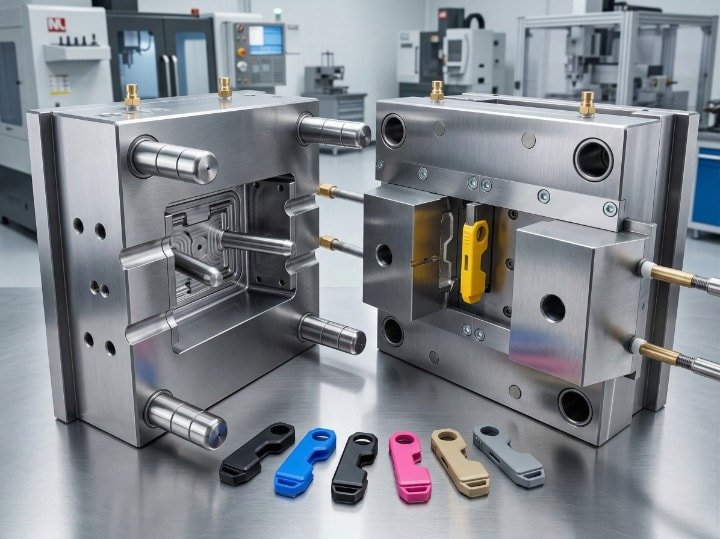
Injection molding works by melting plastic pellets and injecting the liquid resin under high pressure into a custom-machined metal mold cavity. Once the plastic cools and solidifies into the desired shape, the mold opens, and the finished part is ejected. This highly repeatable process is ideal for mass-producing complex, durable plastic components.
🎥 Inside the Machine: Watch this visual breakdown of how the hopper, heated barrel, and reciprocating screw work together to inject molten resin into a precision-machined mold.
The Core Mechanics of the Process
To fully grasp how injection molding operates, it is helpful to understand the primary components of the machinery and how they interact to transform raw material into a finished product:
- Hopper: The funnel-like container where raw thermoplastic pellets are loaded and fed into the machine.
- Barrel & Screw: A heated cylinder containing a reciprocating screw. As the screw turns, it melts the plastic through friction and heater bands, moving the liquid resin forward.
- Nozzle: The interface between the barrel and the mold, ensuring a tight seal so molten plastic is injected directly into the sprue.
- The Mold (Tool): Typically made of steel or aluminum, this is the custom-machined block with a negative cavity of the final part. It contains cooling channels and ejector pins.
- Clamping Unit: The high-pressure hydraulic or electric press that holds the two halves of the mold tightly shut during injection to prevent flashing (leakage).
GBM Pro Tip: In our lab tests at GBM, we found that maintaining precise temperature control across the barrel zones prevents material degradation and ensures consistent part dimensions throughout the production run.
What are the disadvantages of injection molding?
The primary disadvantages of injection molding include high upfront tooling costs, long lead times for mold fabrication, and the difficulty of modifying the mold once machined. Additionally, the process requires strict design constraints to ensure proper part ejection and minimize defects like warping or sink marks.
Key Limitations to Consider
While injection molding is unparalleled for mass production, evaluating its drawbacks is critical for project planning.
| Disadvantage | Technical Explanation | Project Impact |
|---|---|---|
| High Initial Cost | Machining custom molds from hardened steel requires specialized CNC equipment and skilled toolmakers. | Prohibitive for low-volume runs or temporary product lines. |
| Long Lead Times | Designing, cutting, polishing, and testing a mold can take weeks or months before production begins. | Delays time-to-market compared to 3D printing or urethane casting. |
| Inflexibility | “Metal safe” changes (removing steel to add plastic) are possible, but adding steel to the mold to remove plastic is extremely difficult. | Design revisions post-tooling are highly expensive and time-consuming. |
GBM Pro Tip: Our engineers always recommend prototyping with 3D printing before committing to cutting steel, as modifying an existing injection mold is both expensive and heavily disrupts the project timeline.
What are the 4 stages of injection molding?
The four primary stages of injection molding are clamping, injection, cooling, and ejection. First, the mold halves are clamped shut. Next, molten plastic is injected into the cavity. The part is then held under pressure to cool and solidify, before finally being ejected from the open mold.
🎥 The 4 Stages in Action: See the continuous manufacturing loop in real-time, from high-tonnage clamping and injection to rapid cooling and automated part ejection.
The Injection Molding Cycle Breakdown
Every single part produced goes through this precise, continuous loop:
- Clamping: The moving platen pushes the mold halves together. The clamping unit applies massive tonnage to keep the mold completely sealed against the pressure of the incoming plastic.
- Injection: The reciprocating screw pushes forward like a plunger, shooting the melted thermoplastic through the nozzle, down the sprue, through the runners, and into the mold cavity.
- Cooling: Once the cavity is full, the plastic begins to cool and solidify as soon as it touches the internal mold surfaces. Water or oil is circulated through channels in the mold to accelerate this heat transfer.
- Ejection: After the part has reached structural rigidity, the clamp opens the mold. An automated mechanism pushes ejector pins forward, knocking the finished part out of the cavity so the cycle can restart.
GBM Pro Tip: Our technicians often see cycle time bottlenecks during the cooling stage. We optimize conformal cooling channels in the mold design to drastically reduce this waiting period and increase daily yield.
What is injection molding in simple terms?
In simple terms, injection molding is like using a high-tech Play-Doh press or a waffle iron. You melt raw plastic material into a liquid, force it into a hollow metal mold shaped like your final product, let it cool down until it hardens, and then pop the finished piece out.
🎥 Injection Molding Explained Simply: A quick, easy-to-understand animation demonstrating how liquid plastic is forced into a cavity to create perfectly repeatable solid parts.
Everyday Analogies
Understanding the process is easier when compared to common household tasks:
- Baking a Cake: You pour liquid batter (molten plastic) into a cake pan (the mold). The shape of the pan dictates the shape of the cake.
- Making Ice Cubes: You fill an ice tray with water and freeze it. In molding, you fill a metal cavity with hot plastic and cool it down until it becomes a solid object.
- A Syringe: The machine uses a giant heated barrel and a plunger (the screw) to squirt the liquid material exactly where it needs to go under high pressure.
GBM Pro Tip: We often tell our new clients to think of the mold as an ice cube tray. The quality of the final “ice” depends heavily on how well the “tray” is machined and how evenly the material is allowed to cool.
How long does it take to injection mold a part?
The actual cycle time to injection mold a single part typically ranges from 15 seconds to 2 minutes, depending on the part’s size, wall thickness, and material. However, the entire process—including mold design, tooling fabrication, and setup—can take anywhere from 4 to 12 weeks before production begins.
Cycle Time vs. Lead Time
It is important to distinguish between the time it takes to make the mold (lead time) and the time it takes to mold the actual plastic piece (cycle time).
| Phase | Average Duration | Primary Factors |
|---|---|---|
| Tooling Lead Time | 4 to 12 Weeks | Mold complexity, number of cavities, steel hardness, CNC machining hours. |
| Setup & Sampling (T1) | 1 to 3 Days | Machine calibration, dialing in temperature profiles, first article inspection. |
| Production Cycle Time | 15 to 120 Seconds | Part volume, wall thickness, material cooling rate, efficiency of mold cooling channels. |
GBM Pro Tip: In our production runs, we’ve found that maintaining uniform wall thickness in your CAD design is the absolute fastest way to reduce cooling time, which is usually the longest portion of the molding cycle.
How does order volume affect the wholesale price of injection molded parts?
Order volume drastically affects the wholesale price of injection molded parts through economies of scale. Because the high upfront cost of the metal mold is distributed across the total number of parts produced, ordering larger volumes significantly lowers the per-unit cost, making mass production highly cost-effective.
Economies of Scale in Manufacturing
The fundamental financial benefit of injection molding relies on amortization. The more parts you make, the cheaper each part becomes.
- Low Volume (1,000 units): The cost of the mold heavily inflates the price per part. A $10,000 mold adds $10 to the cost of each unit.
- Medium Volume (50,000 units): The mold cost is spread thinner. That same $10,000 mold now only adds $0.20 to the cost of each unit.
- High Volume (500,000+ units): The tooling cost becomes negligible (adding just $0.02 per unit). The wholesale price is now driven almost entirely by raw material costs and machine time.
GBM Pro Tip: Our quoting team always advises clients that the break-even point for injection molding usually hits around 10,000 units. Below that threshold, we might suggest alternative methods like urethane casting or CNC machining.
What are the upfront tooling costs and lead times for custom molds?
Upfront tooling costs for custom injection molds typically range from $3,000 for simple, single-cavity aluminum molds to over $100,000 for complex, multi-cavity hardened steel molds. Lead times for designing, machining, and testing these custom molds generally span between 4 and 12 weeks depending on complexity.
Tooling Investment Breakdown
The cost and time required to build a mold are dictated by the physical demands of the project:
- Material Selection: Aluminum molds (cheaper, 2-4 week lead time) are great for low volumes. Hardened steel like H13 (expensive, 8-12 week lead time) is required for millions of cycles or abrasive plastics.
- Cavitation: A single-cavity mold makes one part per cycle and is cheaper to machine. A 16-cavity mold makes 16 parts per cycle but requires a massive, highly complex, and expensive tool.
- Action Mechanisms: If a part has undercuts or side-holes, the mold requires sliding side-actions or lifters. These moving metal components significantly increase both machining time and tooling cost.
GBM Pro Tip: We always utilize P20 steel for medium-volume production molds in our facility. It offers the perfect balance of machinability for shorter lead times while maintaining enough durability for hundreds of thousands of cycles.
Why Partner with GBM for Your Injection Molding & Tooling Needs?
Sourcing custom injection molds for the international market requires a partner who delivers not just metal and plastic, but transparent communication, precision engineering, and predictable lead times. At GBM, we are dedicated to bridging the gap between world-class mold fabrication and global manufacturing needs.
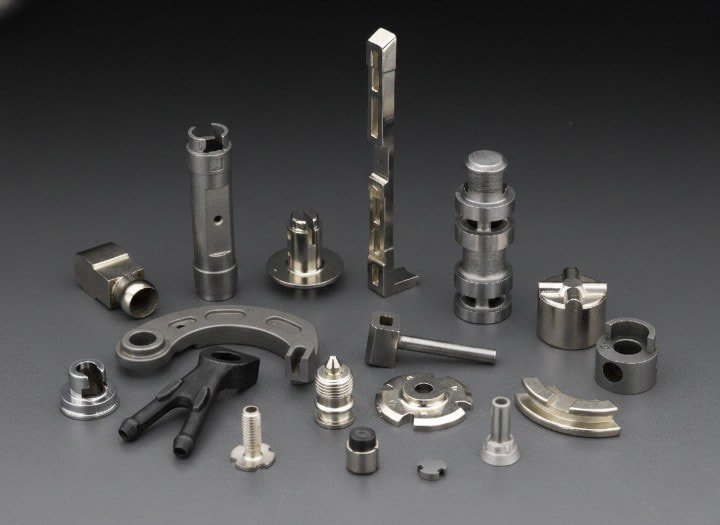
- Export-Grade Tooling Expertise: We don’t just mold parts; we engineer the tools that make them. Our in-house tooling facility specializes in fabricating everything from rapid-aluminum prototypes to high-cavitation, hardened steel (H13/S136) production molds built to strict international SPI and HASCO standards.
- Proactive DFM for Overseas Clients: We know that modifying a mold once it’s built is costly, especially across time zones. That is why GBM’s engineering team conducts an exhaustive Design for Manufacturability (DFM) and Moldflow® analysis before cutting any steel. We identify potential sink marks, optimize cooling channels, and adjust wall thicknesses to ensure your design is perfect on the first shot.
- Transparent Project Management: For our global partners, visibility is key. From the initial CNC machining of your mold to the T1 sampling phase, our team provides detailed, English-language technical updates and inspection reports, ensuring you are always in control of your project’s timeline.
- Scalable Mass Production: Whether you need 10,000 units to test a new market or 5,000,000 units for global distribution, our automated injection molding presses are optimized for maximum efficiency, minimizing cycle times and driving down your per-unit wholesale costs.
Bring your concepts to life with a trusted global manufacturer. Let GBM’s tooling experts reduce your risks and maximize your ROI.
Conclusion
Mastering the principles of injection molding empowers engineers to design scalable, cost-effective, and highly precise plastic components for mass production.
Ready to move from prototype to mass production? Send your 3D CAD files to the GBM engineering team today for a free DFM analysis and an accurate tooling quote.