
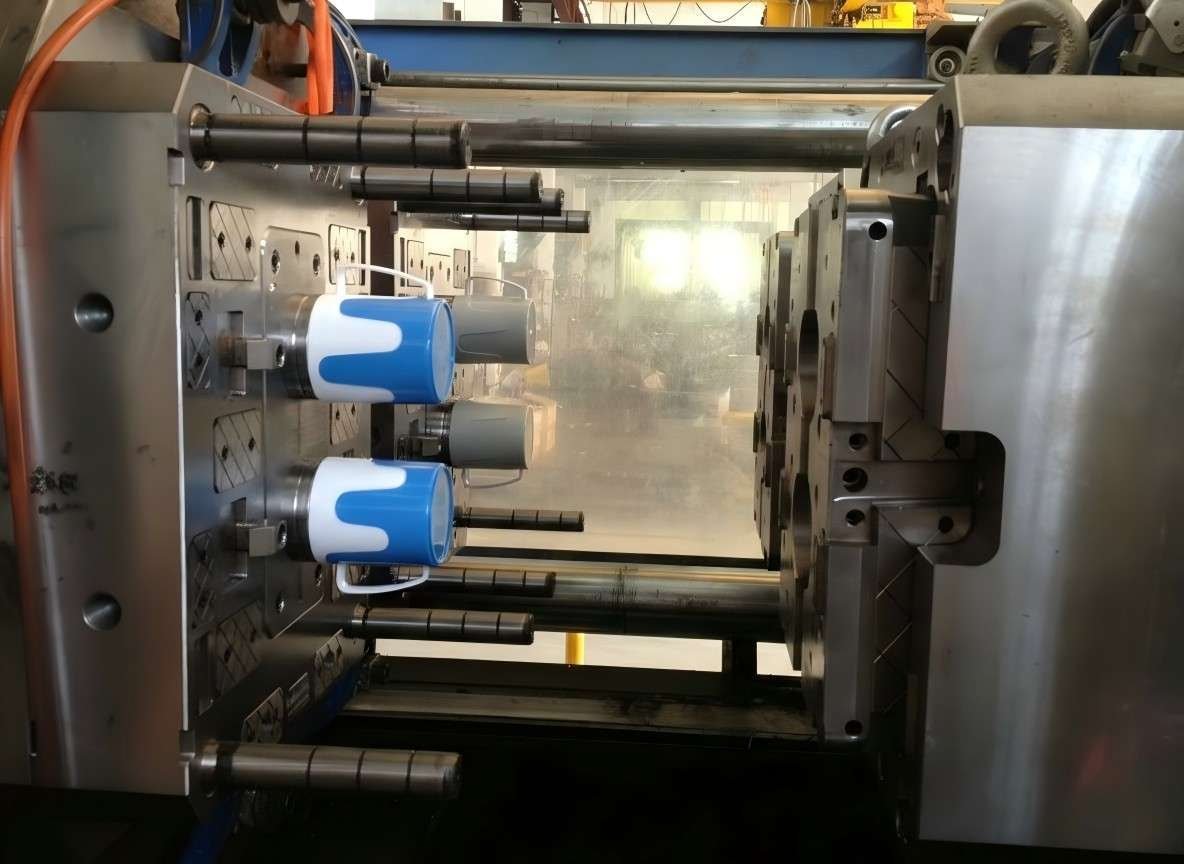
Two-shot injection molding (2K molding) works by utilizing a specialized machine with two separate injection units to mold two different plastic materials into a single part within one automated cycle. The process typically involves a rotary platen that spins the mold 180 degrees after the first material (substrate) is injected, allowing the second material (overmold) to be injected into the remaining cavity, creating a permanent chemical or mechanical bond.
The Mechanical Process Breakdown
The core efficiency of 2-shot molding lies in its ability to consolidate assembly into the molding phase. Unlike standard molding, which requires ejecting a part and moving it to another machine, 2-shot molding occurs inside a single tool.
The 4-Stage Cycle:
- Injection 1 (Substrate): The first material (usually the harder plastic) is injected into the first cavity to form the structural skeleton of the part.
- Rotation/Transfer: The mold opens, and the core plate (usually on a rotary table) rotates 180 degrees, carrying the substrate to the second position.
- Injection 2 (Overmold): The mold closes, and the second material (often a soft-touch TPE or a different color) is injected into the second cavity, bonding to the substrate.
- Ejection: The finished multi-material part is ejected while the first cavity is simultaneously filled again for the next cycle.
GBM Pro Tip: In our lab tests at GBM, we found that optimizing the cooling time of the first shot is critical. If the substrate is too cold, the second shot won’t bond chemically; if it’s too hot, the injection pressure of the second shot can deform the geometry of the first. We aim for a surface temperature window of 40°C–60°C for optimal adhesion between PP and TPE.
What is the two-shot injection molding process?
The two-shot injection molding process is a manufacturing technique that produces complex, multi-material parts by injecting two distinct resins into a single multi-station mold. It relies on a machine equipped with two independent barrels and nozzles that fire sequentially or simultaneously, utilizing a rotating tool to transfer the semi-finished part between injection stations without manual intervention.
🎥 Watch Video: Understanding Two-Shot Injection Molding Machine Configurations
Machine Configuration Types
While the rotary platen is the most common method, the process can be executed through various tool configurations depending on part geometry.
| Configuration | Description | Best For |
|---|---|---|
| Rotary Platen | The moving side of the mold rotates 180° vertically. | High-volume, standard multi-material parts (e.g., toothbrushes). |
| Index Plate | Only a section of the core plate rotates. | Parts where only a small specific area requires overmolding. |
| Core Toggle | A slide or core retracts to open a new cavity space. | Simple geometries where rotation is unnecessary; faster cycle times. |
| Robotic Transfer | A robot arm moves the part to a second cavity. | Lower volume or when using standard machines (less precise). |
GBM Pro Tip: Our technicians often see issues with “flash” on the second shot when using Core Toggle systems. We recommend ensuring your tool steel hardness is above 50 HRC to maintain tight shut-offs over millions of cycles, as the sliding action causes significant wear.
What is the difference between overmolding and two-shot injection molding?
The primary difference is that two-shot molding is a fully automated, single-cycle process performed in one machine, whereas overmolding (or insert molding) typically involves two separate molding steps, often requiring manual or robotic transfer of the substrate into a second mold. Two-shot molding offers superior precision and lower unit costs for high volumes, while standard overmolding is more cost-effective for low-volume production due to lower tooling costs.
🎥 Watch Video: Two-Shot Molding vs. Standard Overmolding: Efficiency and Cost
Comparison: Efficiency vs. Cost
| Feature | Two-Shot Molding (2K) | Standard Overmolding (Pick-and-Place) |
|---|---|---|
| Equipment | Specialized 2-barrel machine | Standard machine (used twice) |
| Cycle Time | Fast (15–40 seconds) | Slow (Two distinct cycles + handling) |
| Tooling Cost | High (Complex rotary molds) | Low (Two simple molds) |
| Part Consistency | Excellent (No realignment errors) | Variable (Depends on placement accuracy) |
| Volume Suitability | High Volume (>10k parts) | Low to Medium Volume |
GBM Pro Tip: We strictly advise clients to switch from manual overmolding to 2-shot molding once annual volumes exceed 50,000 units. At that threshold, the amortization of the expensive 2-shot tool is offset by the massive reduction in labor costs and scrap rates.
What is the process of 2K molding?
2K molding is simply the industry synonym for two-shot molding (“2K” stands for “Zweikomponenten” or “Two-Component” in German). The process focuses on combining materials with different properties—such as rigid plastics with soft elastomers—to create parts with integrated seals, soft-touch grips, or two-tone aesthetics without the need for adhesives or assembly.
Common 2K Applications
- Soft-Touch Grips: Power tools and toothbrush handles (Hard PP + Soft TPE).
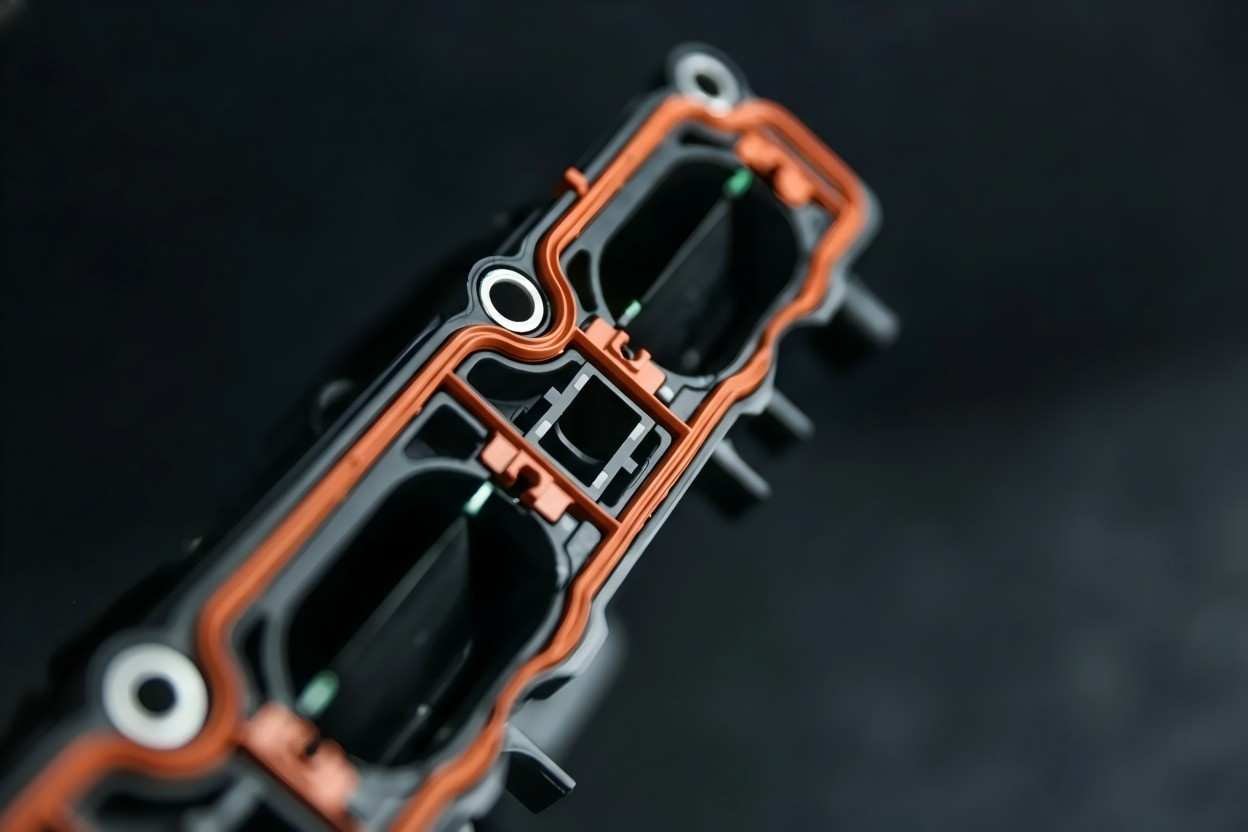
- Integrated Seals: Automotive housings with built-in gaskets (Nylon + Silicone/TPE).
- Movable Hinges: Airtight containers with flexible living hinges.
- Aesthetic Buttons: Dashboard controls with backlit symbols (Clear PC + Black ABS).
GBM Pro Tip: In our facility, we utilize 2K molding to eliminate O-ring assembly. By molding the seal directly onto the housing, we prevent the “rolled gasket” failures that frequently occur during manual assembly lines.
What is the process of dual molding?
Dual molding is a variation of the two-shot process often used to describe co-injection or the layering of materials for cosmetic depth or structural reinforcement. In this process, the machine may inject a skin material followed immediately by a core material (sandwich molding) or use the standard rotary technique to layer transparent resins over colored ones to create depth and protection for graphics.
🎥 Watch Video: The Visual and Functional Benefits of Dual Injection Molding
Visual and Functional Benefits
- Cosmetic Depth: Molding a clear lens over a colored logo prevents the logo from scratching or fading (e.g., automotive badges).
- Light Piping: Directing LED light through specific transparent sections of a mostly opaque part.
- Noise Reduction: Using a soft core material to dampen vibration in gears or mechanical housings.
GBM Pro Tip: We often use dual molding for “regrind encapsulation.” We inject virgin material as the outer skin and use recycled plastic (regrind) as the inner core. This maintains the part’s aesthetic quality while reducing raw material costs by up to 30%.
What are the cost savings compared to manual assembly?
Two-shot injection molding generates significant cost savings by eliminating secondary assembly labor, reducing adhesive or fastener costs, and shrinking inventory requirements. Although the initial tooling investment is higher, the unit cost drops drastically because the part emerges from the mold fully assembled, reducing quality control overhead and floor space usage.
ROI Factors Breakdown
- Labor Reduction: 100% elimination of assembly line workers for that specific component.
- Cycle Time: A 2-shot cycle is often only 10-20% longer than a single shot cycle, essentially producing a “second part” (the assembly) for free in terms of time.
- Inventory Logic: Instead of stocking Part A, Part B, and Glue C, you only stock one SKU (the finished 2-shot part).
- Scrap Rate: Manual assembly often leads to misalignment errors; 2-shot molding utilizes fixed steel cavities for perfect alignment every time.
GBM Pro Tip: When we calculate ROI for our clients, we find that the “Break-Even Point” for 2-shot tooling vs. manual assembly usually hits around 25,000 to 40,000 parts. If you are producing fewer than that, the $50k+ tool might not be justifiable.
Which material combinations ensure strong chemical bonding?
Achieving a strong molecular bond in 2-shot molding requires selecting materials with compatible chemical structures and similar melt temperatures. Generally, materials with similar polarities bond best; for example, TPE (Thermoplastic Elastomer) bonds excellently with PP (Polypropylene) but poorly with Nylon unless a specialized modified TPE grade is used.
GBM Material Compatibility Chart
| Substrate (1st Shot) | Compatible Overmold (2nd Shot) | Bond Strength |
|---|---|---|
| Polypropylene (PP) | TPE / TPV | ⭐⭐⭐⭐⭐ (Excellent) |
| Polycarbonate (PC) | TPU / TPE | ⭐⭐⭐⭐ (Very Good) |
| ABS | TPU / TPE | ⭐⭐⭐⭐ (Very Good) |
| Nylon (PA6/PA66) | Modified TPE only | ⭐⭐⭐ (Requires specific grades) |
| POM (Acetal) | None (Very difficult) | ⭐ (Requires mechanical interlock) |
GBM Pro Tip: We always advise designing “Mechanical Interlocks” even if the materials are chemically compatible. By adding holes, undercuts, or grooves in the first shot for the second shot to flow into, we ensure the soft grip will never peel off, even if the chemical bond degrades over years of UV exposure.
The GBM Advantage: Engineering Excellence in 2K Tooling
Mastering the theory of material compatibility is only half the battle; executing 2-shot molding at scale requires flawless tooling and precise process control. At GBM, we don’t just supply parts—we engineer comprehensive multi-material manufacturing solutions designed for zero-defect production.
Our E-E-A-T (Experience, Expertise, Authoritativeness, and Trustworthiness) in complex injection molding is demonstrated through our rigorous approach:
- Precision Rotary Mechanisms: We design and build ultra-precise rotary platens and index plates that guarantee exact mold registration. This eliminates flash and prevents the crushing of the first shot during the second injection phase.
- Advanced Flow Simulation: Before any steel is cut, our engineers run dual-shot Moldflow analysis. We predict thermal behaviors and optimize cooling channels to ensure the critical 40°C–60°C surface temperature window is maintained for maximum chemical adhesion.
- Robust Tool Steel Selection: To combat the significant wear caused by sliding cores and rotary actions in 2K molds, we exclusively utilize high-grade hardened tool steel (exceeding 50 HRC), ensuring your mold performs consistently across millions of cycles.
- Total Project Management: From initial DFM (Design for Manufacturability) to material compatibility testing and final T1 sampling, our transparent process mitigates risk and accelerates your time-to-market.
Conclusion
Two-shot injection molding is the most efficient method for mass-producing multi-material parts, offering superior bonding, reduced assembly costs, and higher precision than traditional overmolding or manual assembly methods.
Ready to eliminate assembly steps and consolidate your product design? Transitioning to 2K molding requires a manufacturing partner with deep technical expertise. Contact the engineering team at GBM today for a comprehensive DFM review and material compatibility assessment. Let us help you engineer a more profitable, high-performance product.