
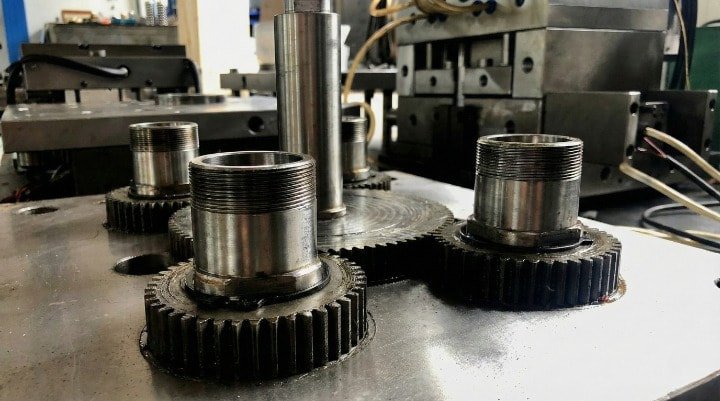
An unscrewing mold is a specialized injection mold designed to manufacture plastic parts with internal or external threads, such as bottle caps, nuts, and medical connectors. Unlike standard molds that simply eject a part, unscrewing molds incorporate a complex rotational mechanism—driven by hydraulic motors, rack and pinion systems, or servo motors—to automatically unscrew the threaded core from the molded part before ejection. This automation ensures high-speed production, precise thread geometry, and eliminates the need for manual unscrewing, making it essential for high-volume manufacturing of threaded components.
Video Guide: A comprehensive review of the mechanisms and design principles behind injection mold unscrewing.
What is Unscrewing Mold?
An unscrewing mold is a precision tool used in injection molding to create parts with detailed screw threads. It features an integrated mechanical system that rotates the threaded cores during the mold open phase, effectively unscrewing them from the solidified plastic part. This technology allows for the mass production of complex threaded items without damaging the thread integrity during ejection.
Video Guide: A demonstration of an automatic unscrew thread injection mold design in action.
Core Definition and Applications
The primary function of an unscrewing mold is to automate the demolding of undercuts caused by threads. While forced ejection (stripping) works for some shallow threads, deep or high-tolerance threads require precise unscrewing to avoid deformation.
Based on our internal data and market analysis, here is the breakdown of common applications:
- Packaging Industry: Bottle caps, cosmetic jars, and closures requiring air-tight seals.
- Plumbing & Irrigation: PVC fittings, sprinkler heads, and threaded connectors.
- Medical Devices: Luer locks, syringe components, and fluid control valves.
- Automotive: Knobs, fluid reservoirs, and fasteners.
- Electronics: Threaded bushings and sensor housings.
GBM Pro Tip: When defining your project requirements, specify the thread standard (ANSI, ISO, DIN) early. Unscrewing molds are highly sensitive to shrinkage rates; a discrepancy in the shrinkage calculation can result in threads that do not mate correctly with their counterparts.
How Does Unscrewing Mold Work?
Unscrewing molds work by converting linear motion (from the mold opening) or rotational energy (from a motor) into the rotation of the threaded cores. Once the plastic part has cooled and solidified, the drive system activates, rotating the cores to unscrew them from the part while a stripper plate typically pushes the part off the core, ensuring a clean separation without thread damage.
Video Guide: Visualizing the rack and hydraulic drive systems used to actuate the unscrewing motion.
Mechanism Types and Operation
The choice of drive mechanism depends on the required cycle time, torque, and precision. The mechanism must be synchronized perfectly with the mold’s opening sequence.
Based on our internal data and market analysis, here is the breakdown of drive mechanisms:
| Mechanism Type | Description | Pros | Cons |
|---|---|---|---|
| Hydraulic Motor | Uses a hydraulic rack or motor to turn a gear train. | High torque, variable speed control. | Can be messy (oil leaks), requires hydraulic core pull. |
| Rack & Pinion | Uses the linear opening of the press to drive a rack gear. | Cost-effective, mechanically synchronized with mold open. | Limited number of turns, dependent on mold stroke. |
| Servo Motor | Electric servo motors drive the gears directly. | Highest precision, clean (no oil), programmable profiles. | Higher initial cost, requires electrical integration. |
| Collapsible Core | The core physically collapses inward to release threads. | extremely fast cycle times, no rotation needed. | Expensive, maintenance-heavy, limited to specific thread geometries. |
GBM Pro Tip: For high-cavitation molds (32+ cavities), we strongly recommend a Servo Motor drive. It provides consistent torque across all cavities and allows for “multi-shot” unscrewing profiles that can reduce cycle times by seconds, which adds up significantly in mass production.
What are the 4 stages of injection molding?
The four stages of injection molding are Clamping, Injection, Cooling, and Ejection. In the context of an unscrewing mold, the Ejection phase is the most critical and complex, as it involves the synchronized rotation of cores to release the threads rather than a simple push-out action found in standard molds.
Video Guide: Observing the complete cycle and design considerations for an auto-unscrewing core mold.
The Cycle Breakdown for Unscrewing Molds
While the standard stages apply, the nuances for unscrewing molds are distinct, particularly during cooling and ejection.
- Clamping: The two halves of the mold are securely closed. The unscrewing mechanism resets to the “mold closed” position.
- Injection: Molten plastic is injected into the cavity. High pressure is maintained to fill the thread details completely.
- Cooling: The plastic solidifies. Crucial Step: The part must be cooled enough to withstand the torque of unscrewing but not so cold that it shrinks too tightly onto the core, which creates excessive friction.
- Ejection (Unscrewing): The mold opens. The drive system rotates the cores. A stripper plate often moves forward simultaneously to prevent the part from spinning with the core, effectively pushing the part off as the core retracts or rotates.
GBM Pro Tip: Optimization of the Cooling stage is vital. If the part is too hot, the threads will strip or smear during unscrewing. If it is too cold, the torque required to unscrew increases drastically, potentially breaking the drive chain or the mold components.
How many times can an injection mold be used?
A high-quality unscrewing mold, typically classified as SPI Class 101, can be used for over 1,000,000 cycles. However, because unscrewing molds contain many moving parts (bearings, gears, racks), their lifespan is heavily dependent on rigorous maintenance, proper lubrication, and the use of hardened tool steels compared to static molds.
Video Guide: Checking the racking and mechanical components is essential for ensuring long mold life.
Mold Lifespan Factors
The longevity of an unscrewing mold is determined by several engineering choices and operational habits.
Based on our internal data and market analysis, here is the breakdown of longevity factors:
- Steel Hardness: Using hardened tool steels (like H13 or S7) for the cores and cavities resists wear from the abrasive plastic and the friction of unscrewing.
- Moving Components: Gears and bearings are wear points. They must be designed for easy replacement.
- Lubrication: Automatic greasing systems are often required to keep the gear train functioning smoothly without contaminating the molded parts.
- Cycle Speed: Running the mold faster than designed generates excess heat in the transmission, accelerating wear.
GBM Pro Tip: We recommend scheduling preventative maintenance on the unscrewing mechanism every 50,000 to 100,000 cycles. Specifically, check the “wear plates” and the condition of the rack teeth. A seized bearing in the gear train can cause catastrophic damage to the entire mold.
Can you DIY injection mold?
You cannot effectively DIY an unscrewing injection mold for production purposes due to the extreme precision and mechanical complexity required. While simple static molds can sometimes be prototyped with aluminum or 3D printing for low volumes, an unscrewing mold requires hardened steel gears, precise bearing alignments, and high-pressure tolerance that cannot be achieved with DIY methods.
Video Guide: The manufacturing process of a helical shaft demonstrates the complexity preventing DIY approaches.
DIY vs. Professional Manufacturing
The barrier to entry for unscrewing molds is significantly higher than for standard open-shut molds.
Based on our internal data and market analysis, here is the breakdown of the challenges:
| Feature | DIY / Hobbyist Approach | Professional GBM Mold |
|---|---|---|
| Tolerances | +/- 0.1mm (often insufficient for threads) | +/- 0.005mm (Required for smooth rotation) |
| Material | Aluminum or Soft Steel | Hardened Tool Steel (50-54 HRC) |
| Mechanism | Hand-loaded inserts (Manual unscrewing) | Fully automatic gear/rack drive |
| Cycle Time | 2-5 minutes per part | 10-30 seconds per part |
| Risk | High risk of flash and thread damage | Guaranteed consistency and thread fitment |
GBM Pro Tip: If you are in the prototyping phase and cannot afford a full unscrewing mold, ask for a “hand-load” prototype mold. In this setup, the threaded core is a loose piece of metal. It is ejected with the part, and the operator manually unscrews it on a workbench before placing it back in the mold for the next cycle. This is slow but cost-effective for testing designs.
Key Features & Comparison
Unscrewing molds are an investment in efficiency. Understanding how they compare to alternative methods helps justify the initial capital expenditure.
Based on our internal data and market analysis, here is the breakdown:
| Feature | Unscrewing Mold | Stripping Mold (Forced Ejection) | Hand-Load Insert Mold |
|---|---|---|---|
| Thread Quality | Perfect geometry, high precision. | Threads must be rounded; risk of deformation. | High precision. |
| Cycle Speed | Fast (Automatic). | Fast (Automatic). | Slow (Manual labor required). |
| Part Geometry | Can handle deep, sharp, and multi-start threads. | Limited to shallow, rounded threads (bump-off). | Any geometry. |
| Mold Cost | High (Complex mechanics). | Medium. | Low to Medium. |
| Maintenance | High (Gears, bearings, racks). | Low. | Low. |
Cost & Buying Factors
When purchasing an unscrewing mold, the price is significantly higher than a standard mold due to the internal mechanics.
- Mechanism Cost: The gear train, bearings, and drive system (hydraulic or servo) add 30-50% to the base mold cost.
- Cavitation: Increasing cavities increases the complexity of the gear train exponentially. A 4-cavity mold is much simpler than a 32-cavity mold.
- Steel Selection: High-wear moving parts require premium imported steels, affecting the price.
- Testing: These molds require longer “T1” testing periods to fine-tune the unscrewing speed and torque settings.
Conclusion
Unscrewing molds are the industry standard for high-volume production of threaded plastic parts. They combine the precision of injection molding with sophisticated automation to deliver consistent, high-quality threads without manual intervention. While the initial investment and maintenance requirements are higher than standard molds, the massive reduction in cycle time and labor costs makes them the most economical choice for mass production. At GBM, we specialize in designing robust unscrewing mechanisms that ensure longevity and precision for your critical components.