
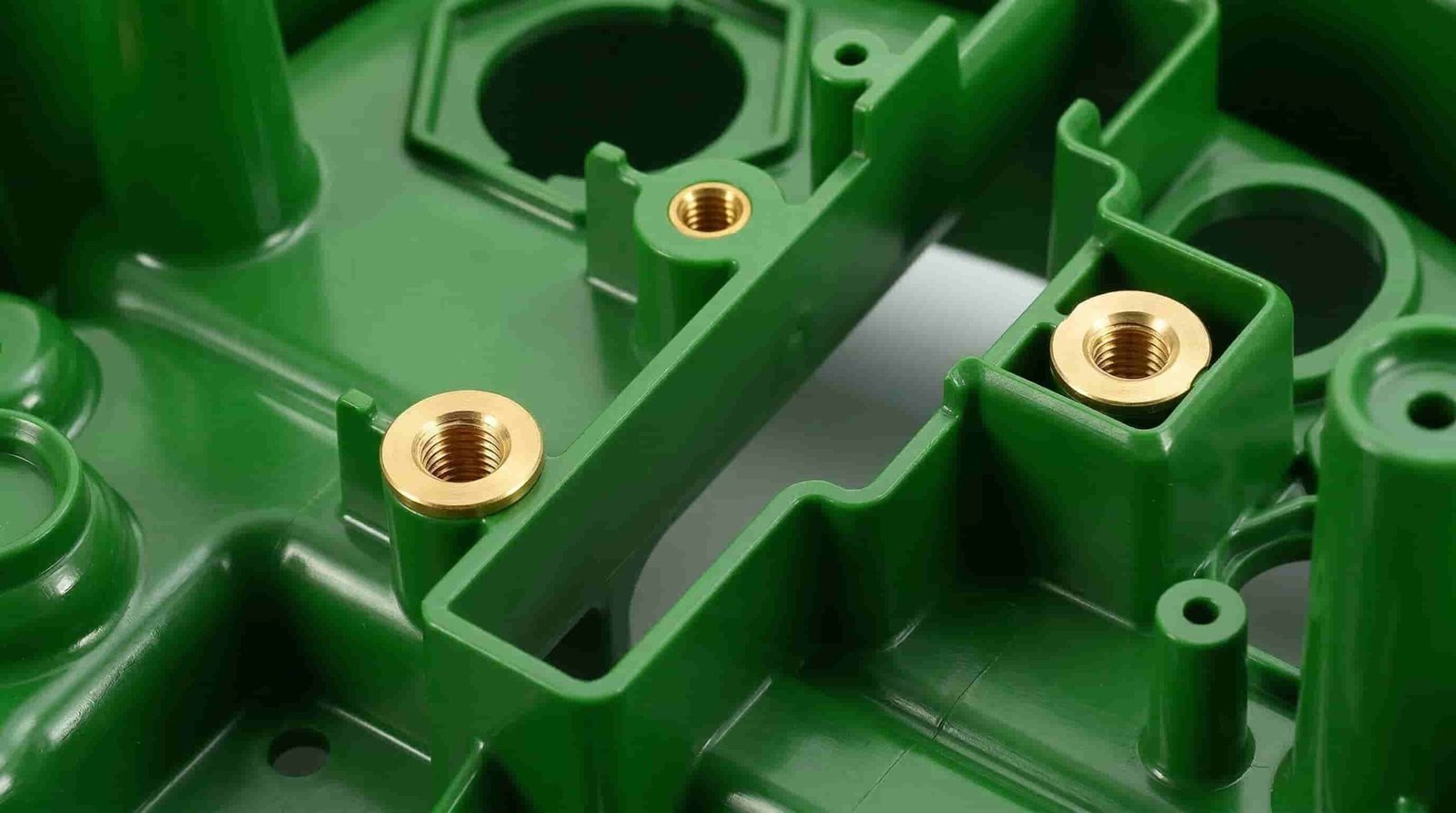
The main difference between an insert mold and an over mold lies in the base material and process sequence. Insert molding involves injecting plastic around a pre-placed non-plastic object, like a metal threaded nut. Overmolding, however, is a multi-step process that molds a secondary plastic or rubber layer directly over a previously molded plastic substrate.
What is an Insert Mold?
Insert molding is a highly efficient manufacturing process where molten plastic is injected around a pre-placed, non-plastic component inside the mold cavity. This technique permanently encapsulates the original part, typically a metal fastener, pin, or electronic component, creating a single, robust assembly without the need for secondary adhesives.
Core Mechanism: The process begins by manually or robotically placing a pre-machined component (the insert) into the mold before the plastic injection cycle starts.
Common Materials: Usually involves a combination of metal (like brass, steel, or aluminum inserts) and a rigid thermoplastic.
Primary Application: Ideal for creating strong attachment points, threaded holes, or reinforcing structural integrity in plastic parts.
🎥 Insert Molding in Action: Watch how molten thermoplastic permanently encapsulates metal fasteners in a single injection cycle to create unbreakable structural points.
What is an Over Mold?
Overmolding is a specialized multi-step injection molding process where two or more distinct plastic or elastomer materials are molded together to form a single unified part. The process involves molding a rigid base substrate first, followed by injecting a softer, secondary material over specific areas to enhance grip, aesthetics, or impact resistance.
Core Mechanism: The rigid plastic substrate is molded first, allowed to cool or transferred to a second cavity, and then the overmold material is injected directly onto it to form a chemical or mechanical bond.
Common Materials: Typically pairs a rigid thermoplastic (like polycarbonate or ABS) with a softer thermoplastic polyurethane (TPU) or thermoplastic elastomer (TPE).
Primary Application: Frequently used for creating soft-touch grips on power tools, sealing electronics, or adding two-tone color aesthetics to consumer goods.
🎥 The Overmolding Process: See how a soft-touch TPE layer is chemically bonded to a rigid plastic substrate to enhance grip, aesthetics, and waterproofing.
Key Differences: Insert Mold vs. Over Mold
While both processes combine multiple materials into a single unified part, they serve entirely different engineering and design purposes.
| Feature | Insert Mold | Over Mold |
|---|---|---|
| Base Material | Usually metal (screws, pins, contacts) | Always a molded plastic substrate |
| Number of Steps | Single injection step over a pre-made part | Two or more sequential injection steps |
| Primary Goal | Adding mechanical strength or threads | Adding soft grip, color, or waterproofing |
| Bonding Type | Mechanical encapsulation | Chemical bonding and/or mechanical interlock |
GBM Engineering Insight: When we design custom components for our clients, we always evaluate the bonding requirements. If you need a structural threaded hole, we strictly recommend insert molding with brass inserts. If you need ergonomic vibration dampening, overmolding a TPE layer is our go-to solution.
Pros & Cons Comparison
| Aspect | Insert Mold | Over Mold |
|---|---|---|
| Pros | Eliminates secondary assembly steps | Creates seamless soft-touch surfaces |
| Highly durable and structurally rigid | Excellent for waterproofing and sealing | |
| Reduces overall part size and weight | Enhances aesthetic appeal with multiple colors | |
| Cons | Requires precise insert placement | Requires complex, expensive two-shot tooling |
| Risk of insert shifting during injection | Materials must be chemically compatible to bond |
Why Trust GBM for Multi-Material Tooling?
Whether you choose insert molding or overmolding, the success of your multi-material part dictates zero margin for error in tooling. Poor mold design leads to crushed metal inserts, or “bleed-out” where the soft overmold material flashes over the rigid substrate. At GBM, our core authority is precision injection mold making, engineered specifically for these complex processes.
- High-Precision In-House Tooling: We build the steel that dictates the quality. For insert molding, we engineer molds with exact-tolerance magnetic pins and crush ribs to securely hold metal components against high injection pressures. For overmolding, we design precise “shut-offs” in the steel to ensure the secondary TPE/TPU layer forms a crisp, flawless boundary line without bleeding.
- Mastering Shrinkage & Bonding: Combining two different materials means dealing with two different thermal expansion and shrinkage rates. Our engineering team utilizes advanced Moldflow® simulations prior to cutting any steel. This ensures perfect mechanical interlocking for inserts and optimal chemical bonding temperatures for overmolds.
- Advanced Two-Shot Capabilities: If your volume justifies it, GBM offers complex rotary or core-back two-shot molding capabilities. We can mold the rigid substrate and the soft overmold in a single, automated machine cycle, drastically reducing your per-part cost.
- Export-Ready Global Standards: We serve demanding industries across North America and Europe. From rugged automotive brackets requiring metal inserts to ergonomic medical devices needing sterilizable overmolded grips, our tooling and final components are rigorously inspected to meet international B2B standards.
Your multi-material project deserves flawless tooling. Contact GBM’s engineering team today for a free Design for Manufacturability (DFM) analysis to determine the most cost-effective molding strategy for your exact application.
Conclusion
Ultimately, choosing between an insert mold and an over mold depends entirely on your project’s functional requirements. Insert molding is the undisputed champion for reinforcing plastic parts with durable metal fasteners, threaded inserts, and electrical contacts. Conversely, overmolding is the ideal choice for enhancing user experience, providing ergonomic soft-touch grips, and creating multi-material waterproof seals.
FAQ
1. Can I use both insert molding and overmolding on the same part?
Yes, it is entirely possible to place a metal insert into a mold, inject a rigid plastic substrate around it, and subsequently overmold a soft TPE grip onto that same substrate.
2. Which process is more expensive to manufacture?
Generally, overmolding requires more complex tooling (often two separate molds or a rotational two-shot mold) and precise material compatibility, making its initial tooling costs higher than standard insert molding.
3. Do overmolded materials peel off easily?
If designed correctly with proper chemical compatibility and mechanical interlocks, the overmolded layer creates a permanent bond with the substrate that will not peel off under normal use.