
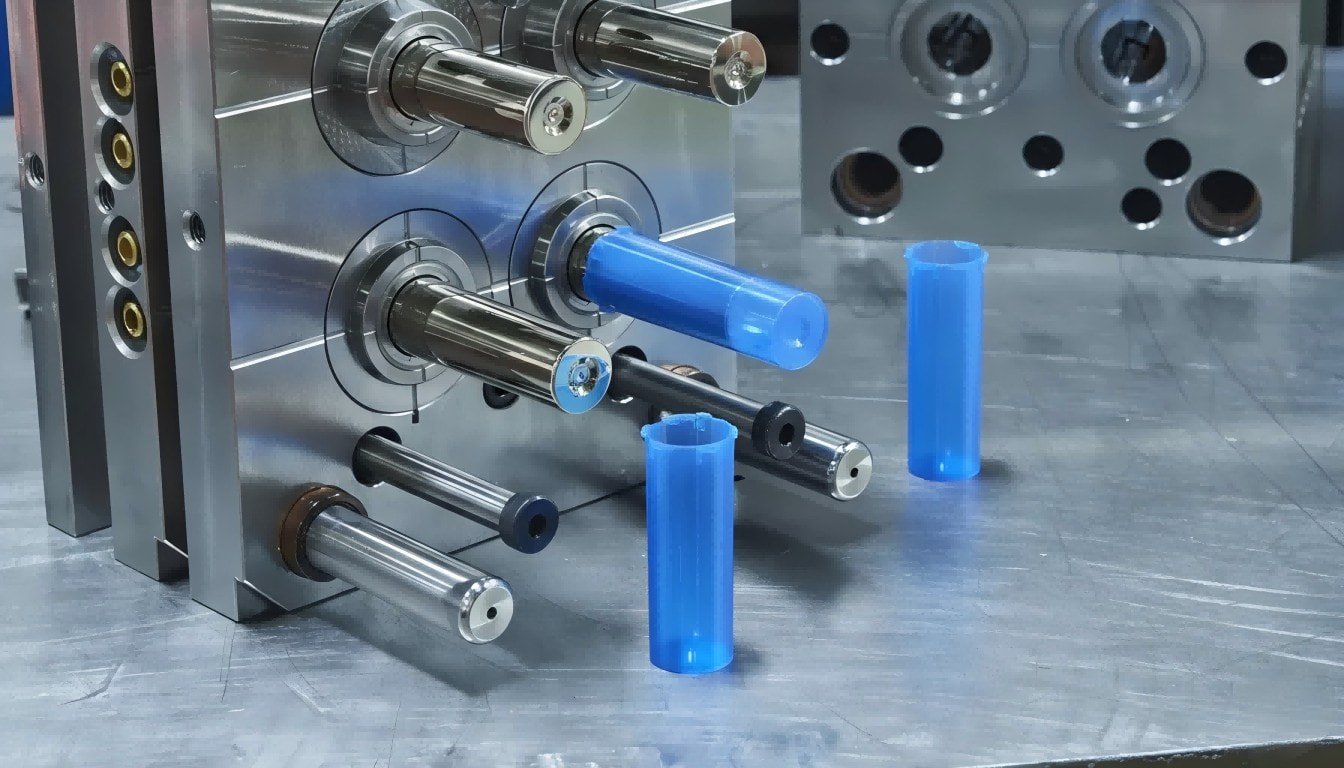
Maximize production efficiency with stack molding, a highly advanced plastic injection process that doubles output without increasing the machine’s footprint or clamp tonnage. By stacking multiple parting lines, manufacturers can drastically reduce part costs, optimize machine utilization, and improve overall cycle times. GBM leverages this cutting-edge tooling technology to deliver high-volume, precision-engineered components for various demanding industrial applications, ensuring maximum ROI on your manufacturing floor.
Video Guide: An excellent overview of how stack molding increases production capacity and efficiency.
What is Stack Mold?
A stack mold is a specialized plastic injection tooling system that features two or more mold parting surfaces stacked parallel to each other. This configuration allows the mold to produce double the number of parts per cycle using the same injection molding machine and clamping force.
Video Guide: A clear visual breakdown of what constitutes a stack mold in the injection process.
Stack Mold Architecture
A standard single-face mold operates with one parting line where the two halves of the mold separate. A stack mold effectively places two single-face molds back-to-back, sharing a central block. This requires highly specialized engineering to ensure the structural integrity of the mold under immense injection pressures.
To fully understand the architecture, consider these core components:
- Stationary Platen: The fixed side of the mold where plastic enters from the machine nozzle.
- Center Block: The middle section containing the hot runner system that splits the molten plastic to both parting lines.
- Moving Platen: The side of the mold that retracts to open the cavities.
- Synchronization Mechanism: Gears or linkages that force all parting lines to open equally.
GBM Pro Tip: Ensure your injection molding machine has sufficient shot capacity and plasticizing rate, as a stack mold requires twice the volume of resin per cycle compared to a standard mold.
How Does Stack Mold Work?
Stack molds operate by utilizing a central block with a hot runner system that distributes molten plastic simultaneously into multiple parting lines. When the machine opens, a mechanical linkage or rack-and-pinion system ensures both mold faces open equally and simultaneously to eject the parts.
Video Guide: A technical demonstration of a stack mold system in active operation.
The Mechanical Synchronization Process
The core of stack molding relies on precise mechanical synchronization. Because there are multiple parting lines, the mold cannot simply pull apart like a standard tool. If one side opens before the other, parts may not eject properly, or the robotic automation systems will fail to extract the components.
The typical operational sequence includes:
- Melt Distribution: The machine nozzle injects plastic into the sprue, which feeds the center block’s hot runner manifold.
- Simultaneous Filling: The hot runner drops the plastic into both the front and rear parting lines at the exact same pressure and temperature.
- Synchronized Opening: Using a helical gear or rack-and-pinion system, the center block is mechanically driven to sit exactly halfway between the moving and stationary platens.
- Ejection: Ejector pins on both parting lines actuate simultaneously to drop or hand off the parts.
GBM Pro Tip: Regular maintenance of the rack-and-pinion or helical gear synchronization mechanisms is critical; even slight wear can cause uneven opening, leading to part defects or catastrophic mold damage.
What are the benefits and drawbacks of injection molding?
Injection molding offers immense benefits, including high efficiency, low per-part costs at high volumes, and excellent repeatability. However, it also presents drawbacks such as high initial tooling costs, lengthy lead times for mold fabrication, and design restrictions related to wall thickness and undercuts.
Video Guide: A comprehensive evaluation of the pros and cons associated with plastic injection molding.
Evaluating Process Viability
Before committing to injection molding—and specifically to advanced techniques like stack molding—it is crucial to weigh the economic and technical factors. While the process is the gold standard for mass production, it requires significant upfront capital.
Based on our internal data and market analysis, here is the breakdown:
| Factor | Benefits (Pros) | Drawbacks (Cons) |
|---|---|---|
| Cost | Extremely low cost per part at scale. | High initial capital expenditure for steel molds. |
| Speed | Fast cycle times; stack molds double this output. | Long lead times (weeks to months) for tooling creation. |
| Quality | High precision, tight tolerances, and repeatability. | Susceptible to sink marks or warping if poorly designed. |
| Materials | Broad compatibility with thousands of resins. | Purging and switching materials can cause downtime. |
GBM Pro Tip: To mitigate high tooling costs, consider family molds or modular mold bases during the prototyping phase before committing to a multi-cavity stack mold for mass production.
What are the 4 stages of injection molding?
The four primary stages of injection molding are clamping, injection, cooling, and ejection. First, the mold halves are securely closed. Next, molten plastic is injected into the cavities. The plastic then cools and solidifies, after which the mold opens to eject the finished parts.
Video Guide: Watch the four stages of injection molding happen rapidly in this 2×24 cavity stack mold.
The Injection Cycle Breakdown
Understanding the four stages is vital for optimizing cycle times. In stack molding, these stages happen simultaneously across multiple parting lines, which makes process control far more sensitive than in traditional single-face molding.
a detailed look at each stage:
- Clamping: The machine’s hydraulic or electric toggle mechanism pushes the mold halves together, applying enough tonnage to resist the injection pressure.
- Injection: The screw pushes forward, forcing molten resin through the hot runner system and into the mold cavities under high pressure.
- Cooling: Water or oil circulates through cooling channels inside the mold steel, drawing heat away from the plastic until it is rigid enough to be handled.
- Ejection: The clamp opens, the synchronization gears separate the parting lines equally, and mechanical pins push the finished parts out of the mold.
GBM Pro Tip: Cooling is almost always the longest stage of the cycle. Optimizing conformal cooling channels within your stack mold can shave seconds off the cycle time, exponentially increasing your daily output.
Who is the largest injection molding company in the world?
While the title fluctuates based on annual revenue and acquisitions, Foxconn and Berry Global are widely recognized among the largest injection molding companies globally. These industry giants utilize thousands of machines, including advanced stack molding setups, to produce consumer electronics, medical devices, and packaging.
Video Guide: An inside look at enterprise-level stack injection molding production environments.
Global Leaders in Plastic Manufacturing
The injection molding industry is highly fragmented, but a few massive corporations dominate specific sectors. These companies invest heavily in automated cells, multi-component molding, and high-cavitation stack molds to maintain their competitive edge.
Notable industry leaders include:
- Foxconn (Hon Hai Precision Industry): Dominates the consumer electronics sector, molding millions of components for brands like Apple.
- Berry Global: A titan in the packaging industry, utilizing high-speed stack molds for caps, closures, and containers.
- Flex (Flextronics): A major player in contract manufacturing, medical devices, and automotive plastics.
- Jabil: Renowned for advanced materials and high-precision molding across diverse global markets.
GBM Pro Tip: You don’t need to be a global conglomerate to achieve massive scale. Partnering with a specialized manufacturer like GBM allows you to leverage enterprise-level stack mold technology for your specific production runs.
Key Features & Comparison
Stack molds provide distinct advantages over traditional single-face molds, particularly in high-volume production environments. Understanding the key features helps in determining if the investment in a stack mold is justified for your specific project.
Based on our internal data and market analysis, here is the breakdown:
| Feature | Single-Face Mold | Stack Mold |
|---|---|---|
| Parting Lines | 1 | 2, 3, or 4 |
| Machine Footprint | Standard | Standard (Requires same clamp tonnage) |
| Production Output | 1x (Base Volume) | 2x (Double Volume per cycle) |
| Tooling Complexity | Low to Medium | Very High (Requires sync gears & hot runners) |
| Initial Cost | Baseline | 1.5x to 2x Baseline Cost |
Cost & Buying Factors
Investing in a stack mold is a significant financial decision. While the tooling itself is more expensive—often 50% to 100% more than a comparable single-face mold—the return on investment is realized through doubled production capacity without the need to purchase a second injection molding machine.
When evaluating a stack mold purchase, consider the following factors:
- Machine Compatibility: Ensure your press has enough daylight (opening stroke) to accommodate the extra thickness of the center block and the dual opening sequence.
- Shot Size Capacity: Your machine’s barrel must hold enough plastic to fill twice the number of cavities in a single shot.
- Hot Runner Quality: The center block hot runner is the most critical component. Invest in premium valve-gate systems to prevent drooling and ensure balanced cavity filling.
- Maintenance Capabilities: Stack molds require skilled technicians for maintenance. Ensure your team is trained to service synchronization linkages and complex manifold systems.
Conclusion
Stack molding is a transformative technology for manufacturers looking to scale production rapidly. By doubling output without increasing clamp tonnage or floor space, stack molds dramatically lower the piece-part cost for high-volume applications like packaging, medical consumables, and consumer goods. While the initial tooling investment and engineering complexity are higher, the long-term efficiency gains make it an invaluable asset. Reach out to the engineering team at GBM today to discuss how a custom stack mold solution can optimize your next plastic injection project.