
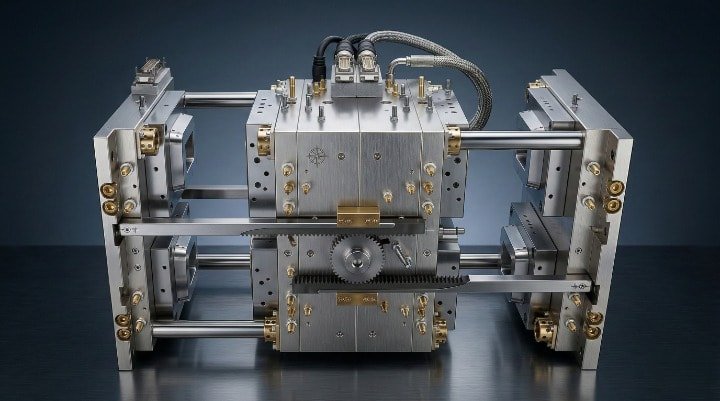
An injection mold is a custom-engineered tool used to manufacture identical plastic parts in high volumes by shaping molten material into a specific design. It is the primary component in the injection molding process, serving as the negative cavity that dictates the part’s geometry, surface finish, and dimensional accuracy for mass production.
🎥 Explore the Core Components of a Custom Injection Mold (Video):
Core Functions of the Tooling
At GBM, we engineer molds not just as containers, but as complex heat exchangers and pressure vessels. The mold must withstand clamping pressures ranging from hundreds to thousands of tons while managing the flow of molten plastic.
The utility of an injection mold is defined by three critical stages:
| Function | Description |
|---|---|
| Forming | The mold cavity (female) and core (male) close to define the exact shape of the part. |
| Cooling | Internal water channels remove heat from the molten plastic to solidify it rapidly. |
| Ejection | Pins or stripper plates physically push the solidified part out of the tool so the cycle can repeat. |
GBM Pro Tip: In our lab tests at GBM, we found that optimizing the cooling channel layout within the mold can reduce cycle times by up to 30%. We always recommend conformal cooling lines for complex geometries to ensure uniform heat dissipation and prevent warping.
What are injection molds used for?
Injection molds are used to produce a vast array of plastic components across industries, ranging from automotive dashboards and medical syringes to consumer electronics housings and bottle caps. They facilitate the rapid, repeatable manufacturing of complex shapes that would be cost-prohibitive or impossible to create using machining or casting methods.
🎥 Video Guide: Top Industries and Products Made with Precision Injection Molds
Industrial Applications
The versatility of injection molds allows us to serve distinct sectors with specific requirements:
- Automotive: Bumpers, dashboards, and under-the-hood components requiring high heat resistance.
- Medical: Syringes, petri dishes, and surgical implants requiring ISO-certified cleanroom molding.
- Consumer Goods: Toothbrushes, toys, and containers utilizing multi-cavity molds for high output.
- Electronics: Connectors, housings, and switches requiring tight tolerances (often $\pm$0.005 inches).
GBM Pro Tip: Our technicians often see clients struggle with material selection for specific applications. We advise defining the environmental stressors (UV exposure, chemical contact) before finalizing the mold design, as different resins shrink differently, affecting the final mold dimensions.
How many times can an injection mold be used?
The lifespan of an injection mold typically ranges from 10,000 to over 1,000,000 cycles, depending on the steel grade and classification. A Class 101 mold, made from hardened tool steel, is designed for extremely high production volumes exceeding one million parts, whereas softer aluminum molds are intended for low-volume prototyping.
🎥 Understanding Injection Mold Lifespans & Class 101 Tooling (Video)
SPI Mold Classifications
To ensure our clients get the right tool for their budget, we follow the SPI (Society of the Plastics Industry) standards:
| Class | Cycles Expected | Material | Typical Use |
|---|---|---|---|
| Class 101 | > 1,000,000 | Hardened Steel (H13, S7) | Extremely high volume, continuous production. |
| Class 102 | < 1,000,000 | Hardened Steel | High volume, abrasive materials. |
| Class 103 | < 500,000 | Pre-hardened Steel (P20) | Mid-range production (most common). |
| Class 104 | < 100,000 | Aluminum or Mild Steel | Low volume, non-abrasive parts. |
| Class 105 | < 500 | Metal/Epoxy | Prototyping only. |
GBM Pro Tip: We insist on regular preventative maintenance for Class 101 molds. We have seen molds run well past 2 million cycles simply by cleaning the vents and lubricating the ejector pins every 50,000 shots.
What is the average cost of an injection mold?
The average cost of an injection mold varies drastically, ranging from $1,000 for a simple, low-volume 3D-printed or aluminum mold to over $100,000 for complex, multi-cavity hardened steel molds. Pricing depends on factors such as part size, geometric complexity, number of cavities, surface finish requirements, and the tooling material selected.
Cost Drivers in Mold Making
When we quote a project at GBM, these are the primary factors that escalate price:
- Complexity: Undercuts requiring “side actions” or “lifters” mechanically complicate the mold, increasing design and machining time.
- Cavitation: A single-cavity mold is cheaper to build but has a higher part price. A 64-cavity mold is expensive to build but yields a very low part price.
- Size: Larger molds require more raw steel and larger CNC machines to cut.
- Surface Finish: High-gloss polishing (SPI A-1) requires manual labor, whereas a textured finish helps hide sink marks but adds chemical etching costs.
GBM Pro Tip: We often advise startups to begin with a “Master Unit Die” (MUD) insert system. This allows you to pay only for the core and cavity inserts while sharing a standard mold base, reducing initial tooling costs by up to 40%.
What can you make with injection molding?
You can manufacture virtually any plastic part with injection molding, including intricate gears, sterile medical devices, automotive bumpers, and everyday household containers. This process supports thermoplastic and thermosetting polymers, allowing for the creation of items requiring high tensile strength, flexibility, or optical clarity, provided the design avoids undercuts or includes side-actions.
🎥 Video: Plastic Material Capabilities in High-Volume Injection Molding
Material Capabilities
The “use” of the mold is largely dictated by the resin injected into it. We work with thousands of materials:
- Commodity Plastics: Polyethylene (PE), Polypropylene (PP) – used for packaging and toys.
- Engineering Plastics: Nylon (PA), Polycarbonate (PC), ABS – used for impact resistance and mechanical parts.
- High-Performance Plastics: PEEK, Ultem – used for aerospace and medical replacements for metal.
- Elastomers: TPE/TPU – used for soft-touch grips and seals.
GBM Pro Tip: In our experience, adding glass fiber reinforcement to the material increases part strength significantly but wears down the mold faster. If you plan to make glass-filled parts, we always specify a hardened steel tool to prevent premature erosion.
What is the wholesale pricing structure for custom injection molds?
Wholesale pricing structures for custom injection molds are typically tiered based on the “cost per cavity” and the amortization of tooling costs over the production run. Manufacturers often offer reduced unit pricing for larger orders because the high upfront investment in the mold is distributed across a greater number of parts, lowering the effective cost per unit.
Amortization Example
Understanding the wholesale structure requires looking at the Total Cost of Ownership (TCO).
| Expense | Low Volume (1,000 parts) | High Volume (100,000 parts) |
|---|---|---|
| Mold Cost | $10,000 | $25,000 (Multi-cavity) |
| Material/Labor | $2.00/part | $0.50/part |
| Amortized Tool Cost | $10.00/part | $0.25/part |
| Total Unit Price | $12.00 | $0.75 |
GBM Pro Tip: We recommend negotiating a “tooling credit” on wholesale orders. If you commit to a certain volume (e.g., 500,000 parts) over two years, we sometimes rebate a percentage of the initial mold cost against future part orders.
How does injection molding reduce per-unit manufacturing costs?
Injection molding reduces per-unit manufacturing costs through economies of scale and high-speed automation. Once the initial mold is created, the cycle time to produce each subsequent part is measured in seconds, requiring minimal labor and generating very little material waste compared to subtractive manufacturing, resulting in drastically lower prices for high-volume runs.
🎥 Video Analysis: Reducing Manufacturing Costs Through Injection Molding Economies of Scale
Efficiency Factors
The cost reduction comes from three main mechanical advantages we leverage at GBM:
- Cycle Speed: A multi-cavity mold can produce 100+ parts every 15 seconds.
- Automation: Robots remove parts and trim gates, meaning one technician can oversee multiple machines.
- Material Regrind: Sprues and runners (scrap) can often be ground up and re-melted into the process, reducing material waste to near zero.
GBM Pro Tip: Our analysis shows that moving from CNC machining to injection molding usually becomes cost-effective once production volumes pass 200-500 units. Below that, the mold cost outweighs the per-unit savings.
The GBM Advantage: Precision Engineering & Advanced Tooling
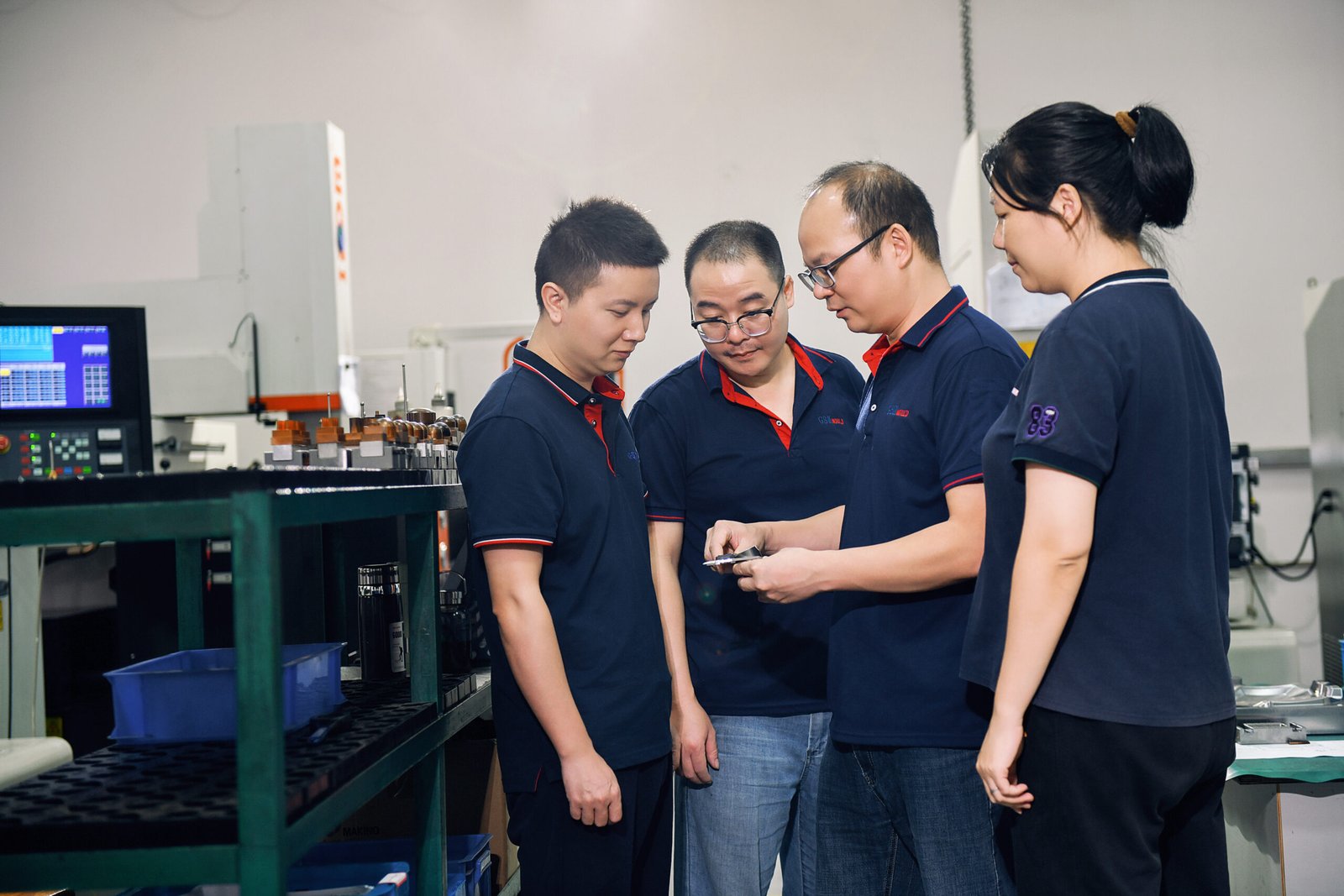
When investing in custom injection molding, theoretical knowledge cannot replace hands-on manufacturing expertise. At GBM, we don’t just quote molds; we engineer high-performance tooling solutions designed for scalability, extreme precision, and long-term reliability.
Our engineering and tooling teams specialize in complex manufacturing challenges that go beyond standard mold-making. We consistently deliver tight-tolerance solutions for our clients, featuring:
- Advanced Mold Technologies: We excel in designing and fabricating high-cavitation Stack Molds and sophisticated Hot Runner molds to maximize your production output while drastically reducing material waste.
- Complex Part Geometries: Whether your project requires precision connector molds for the electronics sector, intricate Unscrewing Molds for threaded components, or 2-shot and Insert Molding for multi-material assemblies, our facility is equipped to handle the most demanding specifications.
- Process Transparency: From initial DFM (Design for Manufacturability) analysis to the final First Article Inspection (FAI), our transparent process ensures that your tooling is optimized for the lowest possible cycle times and the highest part quality.
🎥 See Our Expertise: From 2-Shot and Insert Molding to Complex Hot Runner Systems
Conclusion
Injection molds are the cornerstone of modern plastic manufacturing, transforming raw pellets into precise, high-value products through a perfect balance of pressure, temperature, and engineering design. Understanding the strategic trade-offs between tooling investment, material selection, and cycle times is the key to minimizing your per-unit costs.
Ready to optimize your next manufacturing project? Partner with a team that understands the science of tooling. Contact the engineering experts at GBM today for a comprehensive DFM review and a competitive tooling quote tailored to your production goals.