There are three main types of injection molding machines classified by their drive systems: hydraulic, electric, and hybrid. Hydraulic machines use fluid power, electric machines utilize high-speed servo motors, and hybrid machines combine both technologies to offer a balance of clamping force, energy efficiency, and precise operational control.
🎥 Watch the Drive Systems in Action: See a visual comparison of hydraulic fluid power versus the ultra-precise servo motors used in all-electric molding machines.
Core Drive Technologies Explained
To understand the equipment used in modern manufacturing, it helps to look at the primary drive mechanisms that power the injection and clamping units.
| Machine Type | Power Source | Key Advantages | Ideal Applications |
|---|---|---|---|
| Hydraulic | Hydraulic fluid and directional valves | High clamping force, lower initial cost, durable | Large automotive parts, heavy-walled products |
| All-Electric | Independent servo motors | Extreme precision, up to 70% energy savings, clean | Medical devices, micro-molding, cleanroom parts |
| Hybrid | Servo motor + hydraulic drive | Fast cycle times, energy efficient, strong clamp | Thin-wall packaging, high-volume consumer goods |
GBM Pro Tip: In our lab tests at GBM, we found that transitioning from older hydraulic units to modern all-electric machines reduced our energy consumption by up to 60% while significantly tightening our part tolerance variations.
What are the different types of injection molding machines?
The different types of injection molding machines are categorized primarily by their drive mechanisms into hydraulic, all-electric, and hybrid systems. Additionally, they can be classified by their clamping mechanisms, such as toggle, hydraulic, or hydromechanical clamps, which dictate how the mold is held shut during injection.
🎥 Understanding Clamping Mechanisms: Discover how toggle and straight hydraulic clamps generate the massive tonnage required to keep molds perfectly sealed.
Clamping Mechanism Classifications
Beyond the drive system, machines are often specified by how they generate the massive tonnage required to keep the mold closed under high injection pressures:
- Toggle Clamp: Uses mechanical linkages to multiply force. Excellent for fast cycle times and lower energy consumption.
- Straight Hydraulic Clamp: Uses direct hydraulic cylinder pressure to hold the mold closed. Offers highly adjustable tonnage and accommodates variable mold heights easily.
- Hydromechanical Clamp: Combines mechanical toggles with hydraulic cylinders, primarily used on ultra-large machines (over 1,000 tons) to save floor space while delivering massive force.
GBM Pro Tip: Our technicians often see premature wear on toggle clamps when preventive lubrication schedules are ignored. We highly recommend automated greasing systems for high-cycle production runs.
What are the 4 types of moulding?
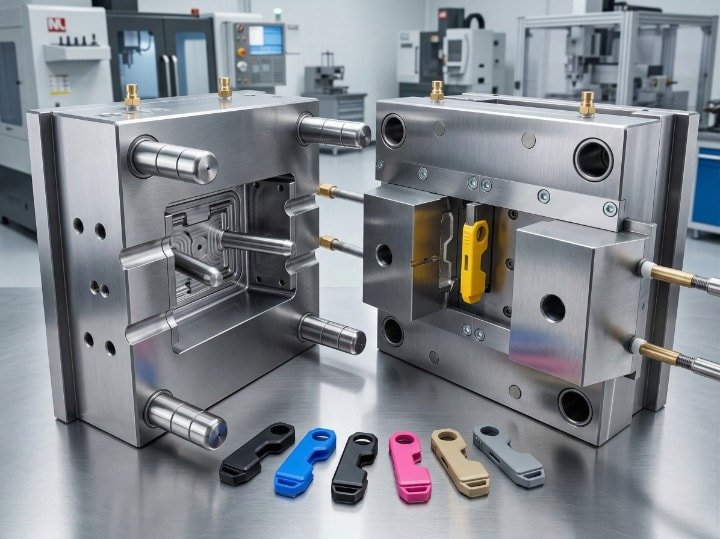
The four primary types of plastic molding are injection molding, blow molding, compression molding, and extrusion molding. Each process is uniquely designed to shape polymers into specific forms, ranging from solid intricate parts and hollow containers to continuous profiles like pipes and flexible tubing.
Primary Plastic Molding Processes
While injection molding is dominant, selecting the right process depends entirely on the part’s geometry:
- Injection Molding: Molten plastic is forced into a closed mold cavity. Used for high-volume, highly detailed solid parts.
- Blow Molding: Air is blown into a heated plastic tube (parison) to inflate it against mold walls. Used for hollow objects like bottles and tanks.
- Compression Molding: Heated plastic material is placed into an open mold cavity, which is then closed under intense pressure. Ideal for high-strength thermosetting plastics.
- Extrusion Molding: Plastic is pushed through a continuous die to create long shapes. Used for PVC pipes, window frames, and wire insulation.
GBM Pro Tip: In our engineering reviews, we always evaluate the part’s cross-section first. If the product requires a hollow center with thin walls, we immediately pivot from standard injection molding to blow molding.
What is the most common injection molding machine?
Historically, the hydraulic injection molding machine has been the most common type used across the manufacturing industry due to its high clamping force and lower initial cost. However, hybrid machines are rapidly becoming the new standard as facilities upgrade equipment to balance power with energy efficiency.
🎥 The Shift to Hybrid & Electric: Learn why the manufacturing industry is rapidly adopting hybrid and all-electric systems to reduce cycle times and energy costs.
Industry Adoption Trends
The landscape of standard machinery is shifting based on energy costs and precision requirements.
| Era | Most Common Machine | Primary Driver of Adoption |
|---|---|---|
| Pre-2000s | Pure Hydraulic | Low capital cost, simple maintenance, sheer clamping brute force. |
| 2000s-2010s | All-Electric | Demand for high precision, cleanroom compatibility, energy spikes. |
| Present Day | Hybrid Systems | Need for fast injection speeds combined with lower operational costs. |
GBM Pro Tip: When our clients ask for equipment recommendations, we usually point them toward hybrid models. They offer the sheer clamping brute force of hydraulic systems that we rely on for large automotive parts.
Who is the largest injection molding company in the world?
While the industry is highly fragmented, companies like Berry Global, Flex, and Jabil are consistently ranked among the largest injection molding companies in the world. These massive contract manufacturers operate thousands of machines globally, serving sectors ranging from automotive and healthcare to consumer packaging.
Top Global Contract Manufacturers
The largest players in the industry achieve their scale through massive global footprints and specialized manufacturing divisions:
- Berry Global: Dominates the packaging, non-woven, and consumer goods sectors with a massive fleet of high-speed machines.
- Jabil: A leader in advanced manufacturing, focusing heavily on precision injection molding for healthcare, electronics, and automotive clients.
- Flex: Provides end-to-end manufacturing solutions, utilizing high-tonnage and micro-molding capabilities for global tech and industrial brands.
GBM Pro Tip: Our market analysis team notes that the largest players dominate by vertically integrating their supply chains. At GBM, we emulate this by keeping our tooling and mold maintenance entirely in-house.
What is the wholesale price difference between hydraulic, electric, and hybrid injection molding machines?
Hydraulic injection molding machines are the most affordable, typically costing 20% to 30% less than all-electric models. Hybrid machines fall in the middle, generally priced 10% to 15% higher than standard hydraulic units, offering a cost-effective compromise between upfront capital expenditure and long-term operational savings.
Capital Expenditure Comparison
When evaluating machinery costs, baseline wholesale pricing varies heavily by tonnage, but the relative price index remains consistent.
| Machine Technology | Relative Wholesale Cost Index | Long-Term Operational Cost |
|---|---|---|
| Hydraulic | $$ (Lowest Upfront) | High (Energy & Oil Disposal) |
| Hybrid | $$$ (Moderate Upfront) | Medium (Optimized Energy Use) |
| All-Electric | $$$$ (Highest Upfront) | Low (Highly Energy Efficient) |
GBM Pro Tip: In our procurement cycles at GBM, we look past the initial wholesale sticker price. We calculate the Total Cost of Ownership (TCO), where electric machines almost always win over a 10-year span due to power savings.
Which type of injection molding machine yields the best ROI for high-volume production?
All-electric injection molding machines yield the best Return on Investment (ROI) for high-volume production. Their servo-driven motors provide faster cycle times, exceptional precision, lower scrap rates, and massive energy savings, which collectively offset their higher initial purchase price over millions of production cycles.
ROI Factors in High-Volume Manufacturing
To achieve rapid ROI in high-volume environments, several operational metrics must be optimized:
- Parallel Operations: All-electric machines allow for simultaneous movements (e.g., ejecting parts while plasticizing the next shot), shaving critical seconds off the cycle time.
- Scrap Reduction: The digital precision of servo motors eliminates the shot-to-shot variation common in hydraulic fluid temperature fluctuations, drastically reducing defective parts.
- Utility Costs: Because electric machines only draw power when a specific motor is moving, they drastically cut the facility’s electricity overhead compared to constantly running hydraulic pumps.
GBM Pro Tip: Our financial models at GBM prove that shaving just 0.5 seconds off a cycle time using an all-electric press translates to tens of thousands of extra parts per month, drastically accelerating our ROI.
Why Choose GBM?
Understanding machine technology is essential, but the true driver of product quality and rapid ROI is the injection mold itself. At GBM, we don’t just operate advanced machinery; we engineer the precision tooling that maximizes their potential.

- Machine-Specific Tooling Design: An all-electric machine’s rapid injection speed can cause “shear burn” if the mold isn’t gated correctly. Our in-house engineers conduct comprehensive Moldflow® analysis to design runners, gates, and cooling channels specifically optimized for the exact drive system and tonnage of the machine that will run your part.
- In-House Mold Fabrication: By keeping our tool and die making entirely in-house, we eliminate the communication gaps between the mold maker and the machine operator. We use premium hardened steel (like H13 or S136) to build high-cavitation molds capable of withstanding the immense pressure of our hydraulic and hybrid presses for millions of cycles.
- Uncompromising Precision: Whether you require the high-tonnage brute force needed for thick-walled automotive components or the micro-precision of a servo-driven electric press for complex electronics, GBM matches your project to the perfect equipment.
- Global Export Standards: We design and build molds to strict international standards (HASCO/DME), ensuring that our tooling performs flawlessly, whether it runs on our factory floor or is exported to your facility overseas.
Your Design. Our Tooling. Perfect Production. Partner with GBM to leverage top-tier machinery and world-class mold engineering for your next manufacturing project.
Conclusion
Understanding the different types of injection molding machines is crucial for optimizing production efficiency, minimizing operational costs, and selecting the exact technology required for your manufacturing success.
Not sure which machine technology is best for your product’s geometry and volume?
Send your 3D CAD files to the GBM engineering team today for a free DFM analysis and production strategy